MultiCare Indigo Fellowship builds successful teams and care
At a glance
- MultiCare’s Indigo Urgent Care fellowship trains new PAs and NPs in-clinic for 14 weeks
- Fellows receive scientifically based hands-on mentorship, weekly case reviews and structured onboarding
- Graduates join a supportive provider network focused on patient experience and clinical excellence
As a recent medical school graduate, Kirra Mandel was looking for a physician assistant fellowship with an organization that offered something unique.
She found just that with MultiCare.
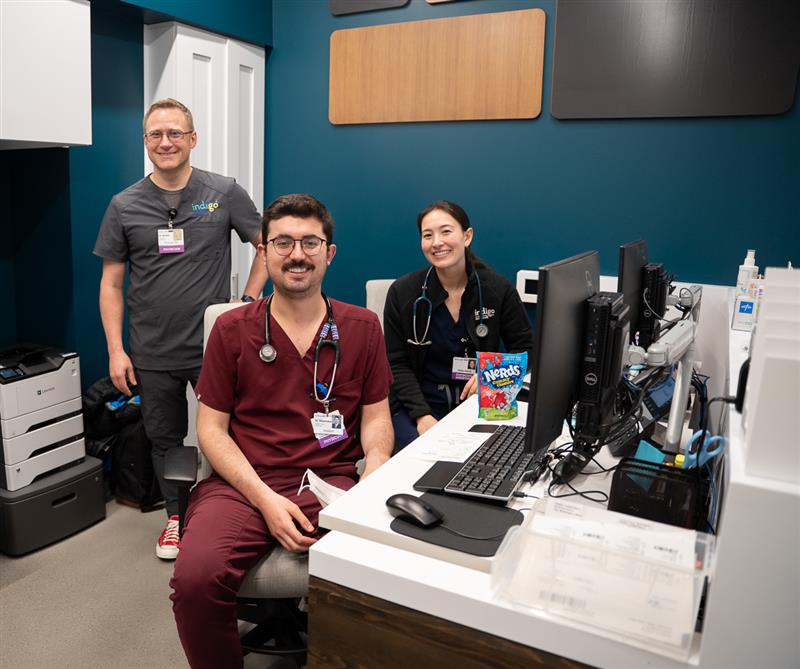
MultiCare’s Indigo Urgent Care Fellowship is a 14-week program that brings in physician assistants and nurse practitioners who have recently graduated or are new to urgent care. They work as full-time employees, side-by-side with experienced urgent care clinicians, to learn the ins and outs of the clinic.
From Indigo’s modern approach to the staff’s dedication to patient experience and peer support, Mandel says the program solidified her choice to join the team. Now she’s paying that forward by mentoring incoming fellows.
A model made by and for providers
The fellowship was spearheaded by Justin Bowles, MD, Indigo medical director of academics.
In 2019, he began working with medical students and residents in the clinic, but wanted to do more. As Indigo leadership saw the value in this work — for the students receiving hands-on experience and training, and in growing access to more qualified providers — they decided to formalize the program.
The fellowship was developed using a scientific-based method to determine qualifications, requirements and structure by a panel of clinic providers and leaders, Dr. Bowles explains.
The result: a comprehensive, personalized and efficient program.
Once accepted into the program, fellows go through a three-day onboarding. This includes an eight-hour Epic training by providers who use the platform daily; three hours learning the Indigo patient experience; and additional refreshers on topics like radiology, EKGs and simple procedures.
Climbing the learning curve together
“Then we get them in the clinic ASAP. We slowly ramp up their patients from one an hour to two an hour,” Dr. Bowles says. “Then over the next 14 weeks they get up to seeing three patients an hour like all of our other providers.”
For many fellows, the fast-paced environment can be daunting at first.
“As with any new job, it’s like drinking from a fire hose at first,” Mandel says. “The shift from being a student to having your own license, it’s very different, and you second-guess yourself a lot in those early days … it’s a lot of different information and types of cases in urgent care … it’s always something new.”
Understanding what that can be like, Dr. Bowles knew it was important to build a support structure into the program.
“Working side-by-side with the providers really helped me grow as a clinician … The preceptors made sure I was able to perform as many hands-on procedures as possible with them by my side, so that I could feel comfortable to do them on my own.” — Tatyana Stepchuk, ARNP
Fellows meet weekly as a group to discuss cases and share learnings, he explains. During clinical shifts they’re paired with provider preceptors, who may shadow them in the room with patients, check in regularly to give feedback and answer questions.
“So often in medical residency you would show up and the doctor would have no idea who you are or how to work with you,” Dr. Bowles explains. “Our trainers know every day what’s going on with the fellows and are very collaborative with the students and other trainers.”
Just having someone to check in with if you need it makes a huge difference, he adds.
As a MultiCare intensive care unit (ICU) nurse for seven years prior to her fellowship, Tatyana Stepchuk, ARNP, was used to caring for one or two patients during a 12-hour shift, allowing her to get to know them and their needs. In urgent care, though, she sees up to 38 patients in a day, meaning she has to be ready for whoever walks in.
From her first day on the floor as a fellow, Stepchuk says she was given room to be independent and gain confidence as a provider, but she also had the reassurance of a team behind her.
“Working side-by-side with the providers really helped me grow as a clinician,” she says. “The preceptors made sure I was able to perform as many hands-on procedures as possible with them by my side, so that I could feel comfortable to do them on my own. This program really helped me with my confidence in being the best clinician I can be.”
An expanding network of support for everyone
After passing their cumulative written and skills test, fellows become full-time Indigo providers, the same as their preceptors. But that doesn’t mean the support stops.
A lot of traditional urgent care clinics are set up as solo practices, which can be intimidating as a new graduate. Plus, you miss out on being able to bounce things off other providers, Mandel explains.
“One thing we do so well is how providers support each other,” she says. “Even if you’ve never met, there’s always someone you can call to get a consult.”
Through the fellowship, not only is the network of providers growing, but so is access for patients, Dr. Bowles says.
“There are many Indigo locations open every day because of the fellowship, because so much of our workforce has come out of it,” he explains. “Not only are these fellows trained at the highest academic levels for urgent care so they’re delivering top-notch, evidence-based medicine, but they also have a really strong emphasis on patient experience.”
Indigo Urgent Care is committed to delivering accessible, patient-focused, efficient and high-quality care, Dr. Bowles says. And that mentality is built into the fellowship.
“This fellowship really opened my eyes about that aspect of medicine. We are there to make people feel comfortable, heard and provide the best care we can,” Stepchuk explains. “Yes, we’re retail medicine, so our patients are customers who choose to come to us and we need to treat them with respect and acknowledge that … because we know that next time they need care they still have a choice, and we want them to come back to us and know they’re going to get top-level care.”
What's next
- Interested in becoming an Indigo fellow? Learn more here
- Explore other career opportunities with MultiCare
- Be prepared for the unexpected and find the Indigo closest to you