‘Liquid gold’ — MultiCare teams up with Northwest Mothers Milk Bank to nourish infants
At a glance
- Northwest Mothers Milk Bank provides safe donor breastmilk to vulnerable infants
- MultiCare hospitals joined the donation effort by opening on-campus milk drop sites
- Donor milk supports NICU babies when mothers face supply challenges, ensuring safe, nutrient‑rich food
Each woman enters motherhood in their own way. Sometimes those circumstances can affect their ability to breastfeed.
Some may have trouble producing milk for any number of reasons; others may be recovering from a physically difficult delivery and unable to produce. Some premature newborns need more than mom can supply.
That’s where Northwest Mothers Milk Bank (NWMMB) comes in.
NWMMB is the only Pacific Northwest-based nonprofit human milk bank, supplying nearly 700,000 ounces of milk each year to infants in more than 90 hospitals across five states, explains Joanne Ransom, BSN, RN, IBCLC, clinical director for NWMMB.
NWMMB was established in 2009 as a nonprofit to offer safe, accredited breastmilk collection, storage and distribution, as well as outreach and education, she says. The organization joins 31 other nonprofits nationwide that collectively distributed 13.1 million ounces of breastmilk in 2025.
As long-time partners and recipients of that milk, the MultiCare Deaconess Hospital mother-baby team saw the need growing for safe, antibody-rich breastmilk and wanted to be part of the solution.
A collective effort to feed newborns
In 2025, Deaconess and MultiCare Mary Bridge Children’s Hospital both opened in-hospital NWMMB drop sites to provide easier access for local mothers to donate breastmilk.
“We’ve used NWMMB for years to provide breastmilk for our infants in the neonatal intensive care unit (NICU) … and we wanted to bring that full circle,” says Kendra O’Brien, Deaconess clinical dietitian.
Deaconess receives approximately 1,500 ounces of donated milk per month for vulnerable newborns, which is equivalent to 140 gallons annually, she says.

Interested in donating?
They’ve also received thousands of ounces to put into the milk bank. Between March and December 2025, the Deaconess drop site received 7,357 ounces of donated breast milk, which is safely transported to the NWMMB facility for processing.
MultiCare patients are now receiving milk that was likely donated by their neighbors, says Sarah Hurley, BSN, RNC-NIC, Deaconess NICU manager.
“It’s nice to have somewhere in the community, in a trusted environment to drop if off … and give back to your own community,” Hurley says. “Families get to know that their milk is doing something good, right here.”
It really is a community effort to feed these babies, Ransom says. And mothers have been eager to be part of that.
“Our first mom who donated had her baby in our NICU for a few weeks. Breastmilk and feeding was important to her, but she couldn’t do skin-to-skin like she wanted, which can harm milk production,” O’Brien explains. “Under the stress of that situation, it was so comforting to have this option for her baby. They came back when her child was 1, to the grand opening of the milk drop site, to donate.”
NWMMB cannot fulfill their goals without the generosity of donors, Ransom says.
“They’re the ones taking care of these babies,” she adds. “Each donation and donation drop site ensures there’s enough milk for us to redistribute.”
Following the NWMMB mission to improve the health and survival of the most vulnerable infants, like those in the NICU, nearly 87 percent of its supply goes straight to NICU babies each year, Ransom explains.
“We believe that every baby deserves access to human milk, and the way we do that is by safely collecting and distributing it to medically fragile and vulnerable babies,” she adds.
The importance of breastmilk and access
For NICU babies, breastmilk is “liquid gold,” O’Brien says. Formula has come a long way over the years, but it still doesn’t compare to the naturally occurring antibodies, probiotics and prebiotics found in breastmilk. It’s also easier on premature newborns’ digestion.
But not every new mother can produce milk right away, or produce enough of it — and some won’t be able to produce at all. The milk bank can give mothers peace of mind and take off the pressure, O’Brien explains.
“So we’re there to help fill that gap in those early weeks,” Ransom says.
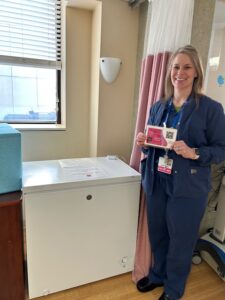
MultiCare Deaconess Hospital NICU manager Sarah Hurley, BSN, RNC-NIC, shows off the new Northwest Mothers Milk Bank drop site for local moms.
While bioidentical breastmilk from an infant’s mother will always be best — a mother’s body responds specifically to their infant’s needs — there’s still more benefit from donated breastmilk compared to dairy milk or formula, explains Hurley.
The longer a baby is in the NICU, the more likely mothers are to end up with supply issues, she adds. The female body responds differently when producing with a breast pump compared to breastfeeding, causing supply to dwindle. Their supply may come back later or just be delayed, but NWMMB ensures babies don’t go without breastmilk in those critical first few days or weeks, Ransom says.
On the other hand, milk banks also are a great option for mothers who may have the opposite challenge and want to give back to others. Some mothers produce more milk than their baby needs and find themselves with overfull freezers, Ransom explains.
“To take that extra milk and dump it down the drain is disheartening because she knows how valuable it was to her own baby,” she says. “The hours she spends pumping, storing it and keeping it safe, it doesn’t make sense to discard it. We give her the ability to share that in a way that can make a difference.”
And for mothers whose newborns have died, donating can also make a huge difference in their grieving process, Ransom adds.
“Being able to experience a small part of being a mother when they didn’t get to take their baby home, and to help feed another baby, can help them to grieve and cope,” she says. “Sometimes the pain of that can be too much and that’s OK, but for some it’s simply a way to honor their baby.”
NWMMB ensures trusted, safe milk for your baby
Mothers receiving NWMMB milk can rest assured their newborn is getting safe, nutrient-rich food with each sip — the nonprofit follows strict screening, pasteurization and storage processes.
Potential donors go through a four-step screening process, including a health history review signed off by their doctor or other health care provider, a review of their lifestyle and motivation for donating, as well as a blood test, Ransom explains.
Once approved, they’re assigned a number that will follow their milk through the entire process until it’s distributed. Donations must be a minimum of 100 frozen ounces at a time, which can be either dropped a donation site or mailed following strict packaging guidelines.
The milk is then analyzed, pasteurized to kill any bacteria or viruses, given an expiration date, and refrozen until it’s sent out for distribution. Analysis includes looking at the fat, protein and lactose amounts for proper labeling, which can be used by clinical dietitians like O’Brien to meet the unique nutrient needs of each infant.
What's next
- Learn more about Northwest Mothers Milk Bank
- Find a MultiCare donation site near you
- Looking for breastfeeding support? Check out MultiCare’s support services