People Living with Dementia program helps patients feel less isolated
The code-gray calls came all too frequently from the fourth floor of MultiCare Auburn Medical Center earlier this year. This code is called for support with a combative person.
The bulk of these calls were for 84-year-old Patti Crabtree.
More than once, nurses saw Crabtree grab her walker and head for the doors, determined to bust out. Crabtree’s dementia wouldn’t allow her to understand that she was in the hospital for her own safety. In her mind, the staff were keeping her from home for no reason. And she was done with all that.
Cathy Cooper, a palliative care social worker at Auburn Medical Center, thought she had a solution. Maybe Crabtree just needed a little more human contact, some interaction that could reach through the clouds in her mind.
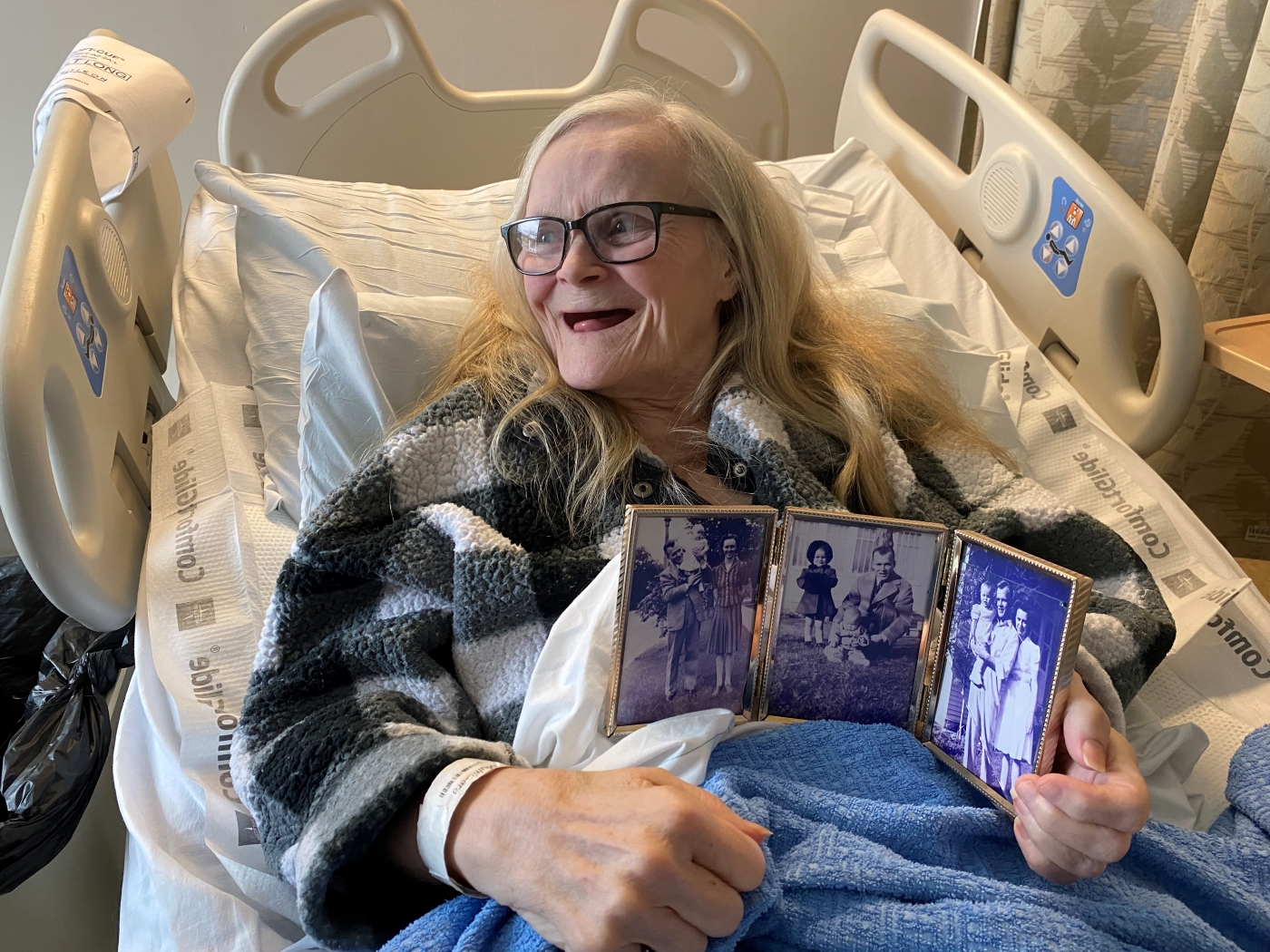
Patti Crabtree shows photos of herself and her parents to her volunteer visitor.
Everyone knows that staff are already stretched thin providing care to a unit packed with patients. Who else might have the time to spend with Crabtree?
Volunteers are doing that now in a pioneering program in MultiCare’s South King region, which includes Auburn and MultiCare Covington Medical Center.
Last fall, Cooper partnered with Jaime Garcia, volunteer services coordinator for the South King region, and the People Living with Dementia project was born.
“I’d see these patients come in here confused, anxious and not knowing what’s going on,” Cooper says. “What we needed was someone who could be with these patients for a few hours. Let them know someone cares about them.”
Training for human contact
With a background in social work and caring for psychiatric patients, Garcia immediately embraced the idea for the program.
Within weeks he gathered the first handful of volunteers, and Cooper led them through how to work with people living with dementia. The training was based on the groundbreaking work of Teepa Snow, a renowned authority on all aspects of dementia.
Volunteers first learned that dementia is an umbrella term that covers more than 120 types, forms and causes of brain change. Significantly, they learned the four truths about dementia:
- At least two parts of the brain are actively dying
- Dementia is progressive and constantly changing
- It’s a chronic condition; there is no cure
- It’s terminal
As training progressed, it became clear that volunteers would be working with patients for whom the world was slowly fading away.
Results so far
The People Living with Dementia program seems to be working — Crabtree is proof.
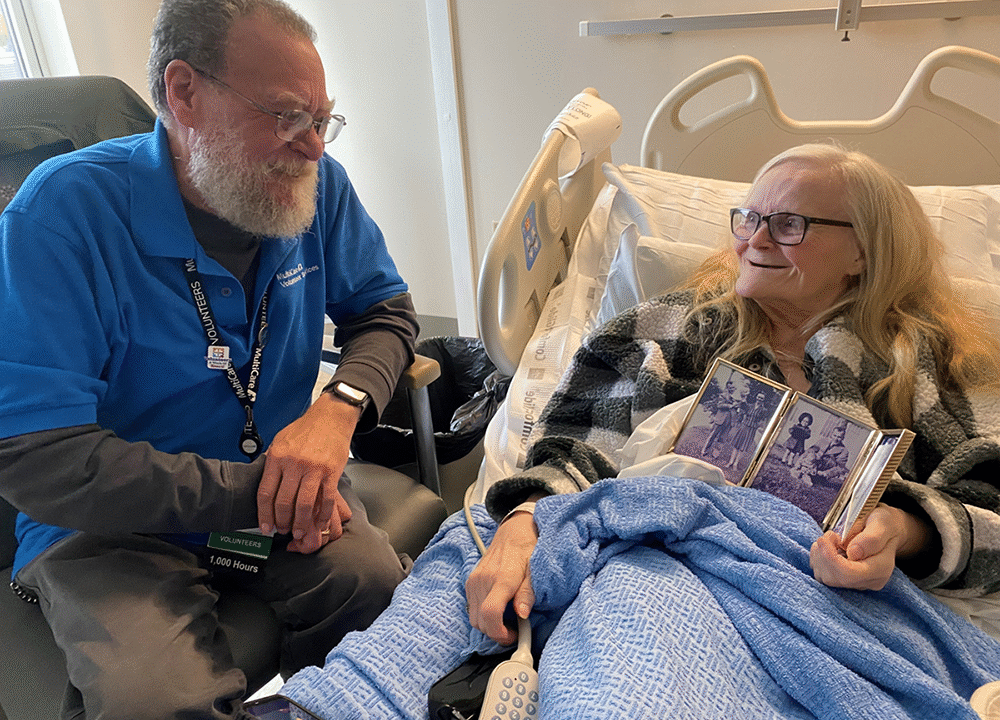
When volunteers visit, she loves to talk and share her life story. She enjoys listening to smooth jazz and playing cards with her visitors. Since volunteers began visiting her, code gray calls to Crabtree’s room have stopped.
“He comes every Wednesday. It really makes my day,” says Crabtree of one particular volunteer. “I always make sure that chair is here and ready for him. No one else can sit there. We play cards and listen to music.
“I really like jazz,” she continues. “I’ll even dance sometimes.”
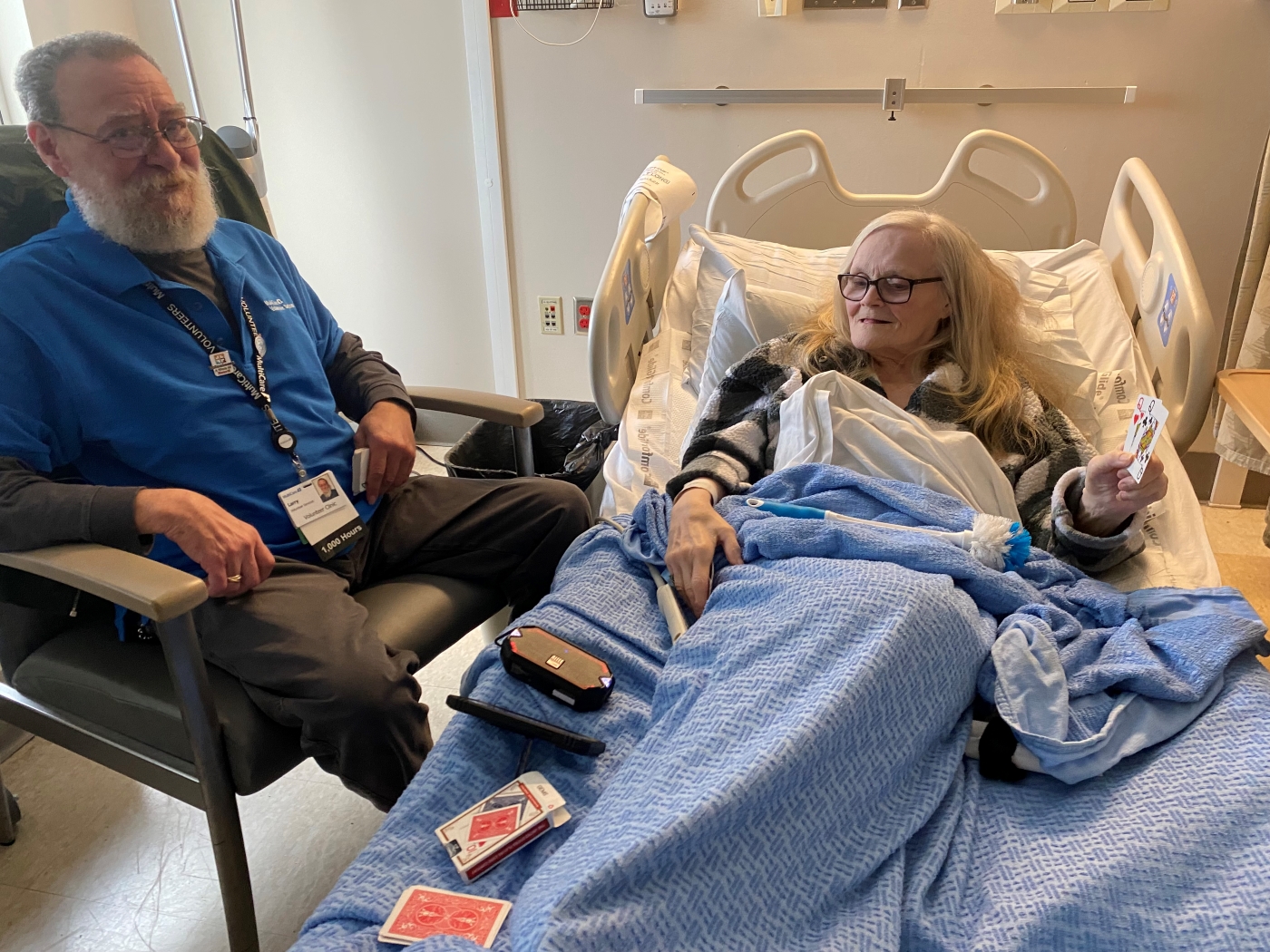
Volunteer Larry Campbell sees he lost another hand of cards to Patti Crabtree. Campbell visits once a week as part of a volunteer program to spend time with dementia patients. The two chat, play cards and listen to music.
Cooper is quick to add that it’s not just volunteers who have helped. Other staff members, including nurses, certified nursing assistants (CNAs), the hospital chaplain and physicians have all adopted the practice of spending a little more time with patients like Crabtree.
CNA Kristina Michael can attest to the benefits of those few extra hours of companionship a week.
“(Crabtree) was a little restless a few days ago and was wanting to get up and get out,” Michael says. “But I reminded her that if she left, she’d miss listening to the music. She calmed right down. The volunteers are really helping to make a difference.”
The impact of those extra contact hours with volunteers has been meaningful. Recently one of Cooper’s colleagues, Madison Severson, MSW, stopped by Crabtree’s room to check on her.
“The patient talked about having many visitors at bedside,” Severson reports. “And she denied feelings of isolation or loneliness.”
Cooper was recently awarded a $3,000 grant from the MultiCare South King Foundation that allowed her to assemble an activity cart filled with tactile objects, board and card games, and other items volunteers can use with patients to stimulate their minds and encourage bonding and communication.
Arun Mathews, MD, chief medical officer for Auburn and Covington medical centers, is encouraged by the program and sees potential for its growth.
“We have overall an aging population in this country, and competence around dementia is going to be essential for all of us,” Mathews says. “I think this program is a wonderful example of stewardship and leadership on this challenge. Hopefully, we can become a model for other hospitals.
“And Cathy (Cooper) is truly an evangelist for this kind of care,” he adds.