Learning to love — YWCA empowers teens to prevent dating violence
At a glance
- One in four teens will experience intimate partner violence between ages 16 and 24
- YWCA’s dating violence prevention program help teens recognize healthy vs. unhealthy behaviors
- Find nonconfrontational ways to talk to your teen from a place of concern, not accusation
Relationships can be complicated. Whether you’ve known your partner for five months or five years, not every day will be perfect. And that’s fine — healthy, even.
Relationships can be complicated. Whether you’ve known your partner for five months or five years, not every day will be perfect. And that’s fine — healthy, even.
The teams at YWCA Spokane and YWCA Pierce County remind us that the signs of a healthy relationship aren’t whether we face challenges, but how we respond to them.
For many, our reactions to intense emotions are ingrained in us as children.
“Dating violence can begin as early as sixth grade,” says Chloe Bolz, support advocate for YWCA Spokane. “We see abuse occurring in intergenerational cycles when unhealthy behaviors are normalized in childhood.”
YWCA Spokane and Pierce County are nonprofits that provide a range of services to survivors and families of intimate partner violence, including emergency shelter, counseling and advocacy, teen dating violence prevention, housing, child care, and job readiness support.
YWCA Pierce County’s teen dating violence prevention programs focus on giving students the ability to recognize healthy versus unhealthy behaviors and empowering them to break the violence cycle.
According to YWCA data, one in four teens will experience intimate partner violence between the ages of 16 and 24. Anyone can display behaviors on both ends of the spectrum, regardless of gender.
“That is how we start the conversation,” says Shamiya Anderson (she/her), youth advocate at YWCA Pierce County. “A lot of times they think ‘Oh, that could never happen,’ but that is one in four people who they know.”
Those statistics helps teens understand they’re not alone in what they experience, explains Rey Ward (they/them), youth advocate at YWCA Pierce County.
Oftentimes, teens don’t realize their own relationship history may put them in the category of a survivor, they add.
Healthy vs. unhealthy relationships
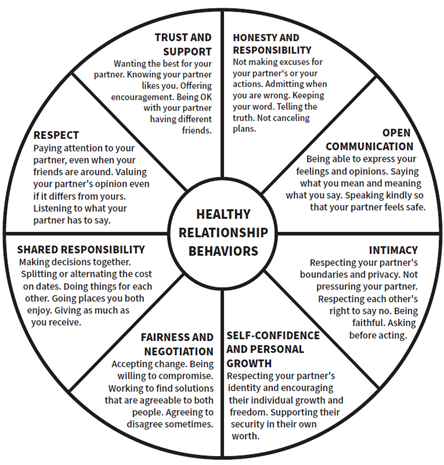
The Teen Power and Control Wheel and Healthy Relationship Behavior Wheel (pictured) provide examples of what YWCA categorizes as common teen relationship behaviors.
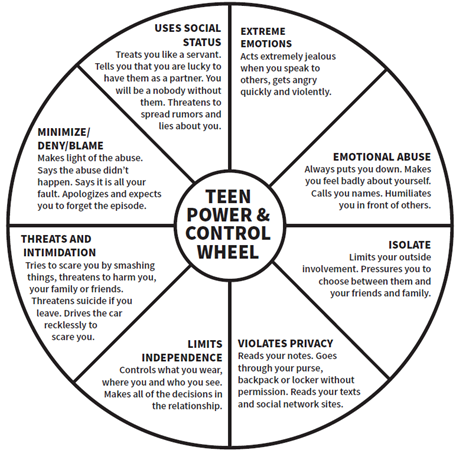
As part of their education materials, YWCA staff present scenarios from the wheel that teens may encounter in relationships — whether romantic, friendship or familial — and ask for their view.
For example, they may pull the “emotional abuse” category from the Power and Control Wheel and talk through how it corresponds to the category of open communication (being able to express your feelings and opinions) from the corresponding healthy behavior wheel.
Some behaviors can be trickier, though, such as jealousy.
“Jealousy is a normal part of a dating relationship,” explains Ward.
While some teens may not agree with that, Ward says, how someone reacts to the jealousy defines the relationship. If a person responds by limiting who their partner can talk to, that would be an unhealthy response. But allowing it to be a conversation starter allows both partners to get more out of the relationship.
Creating a space for conversation
YWCA’s services center around the belief that participating in an unhealthy behavior doesn’t make a teen a bad person, explains Sojourner Duxbury (she/her), education and prevention manager at YWCA Pierce County.
“It’s a behavior, not a person,” Ward adds. “We often leave them with the phrase ‘Once you know better, you can do better.’”
To know better, though, conversation must be had.
“Many participants come to YWCA without any real-life examples of healthy relationships,” Bolz says. “We do not tell these individuals they are wrong but instead explore how healthy and unhealthy behaviors make us feel.”
Prevention staff also address the root causes of socially acceptable relationship behaviors, Duxbury adds, such as social media, which has played a major role in those beliefs.
“It’s about what we learn from society, our parents, etc.,” she says. “We’ve seen it in ‘Mean Girls’ with ‘On Wednesdays we wear pink.’ We want to recognize those smaller behaviors and how they can get bigger.”
Many of these topics are ones that teens never get asked their opinion on, Anderson adds. Giving them the opportunity to take a stance can empower them to ask for help, say no or start the conversation with others.
Even with those skills, the conversation can be daunting, especially with those we’re closest to.
Parents often question why their child won’t confide in them, Ward says. For some teens, their parents may be a safe home but not their safe emotional space.
Conversation starters
“I’ve noticed your partner gets upset if you don’t respond to a text. Why?”
“Do you usually have to check in before you do something?”
“I’m coming from a place of concern. I just want to know what’s going on.”
“Maybe it’s not you, so get out of the way and let them find somebody else who they can relate to,” Ward says. “For me, I had youth group, school counselors or an older queer person. … It doesn’t have to be you, but it has to be someone safe.”
Whether you’re a parent, friend or other safe adult figure, Bolz says it’s important to be aware of the warning signs and find nonconfrontational ways to raise the question from a place of curiosity, not accusation.
Relationships can be hard at any age, but through education and communication, we can demonstrate healthy behaviors and hopefully break the cycle of intimate partner violence.
Visit the YWCA Spokane and YWCA Pierce County websites for more information, access to resources or tips on how to speak with your teen or friends about healthy relationships.
What's next
- Visit the YWCA Spokane and YWCA Pierce County for tips on talking to your teen about relationships
- Green, beige and red flags: Signs of a healthy relationship
- Teen girls’ mental health at risk — what can parents do?