Man avoids stroke complications with prompt care

George Young is an active 70-year-old from Puyallup. He plays golf regularly, is in a bowling league and goes to the gym with his wife Cathy three to four times a week.
One morning before heading to the gym, he wasn’t feeling quite right, so he stayed behind to rest.
Within 40 minutes, he couldn’t move his right leg or arm.
“I was sitting there thinking, ‘I’m having a stroke,” he recalls.
Young, a retired senior manager at Boeing, had done many safety trainings, so he was familiar with the BE FAST symptoms of stroke.
“I wasn’t slurring my speech; my face and eyes weren’t drooping — but because I couldn’t move my arm and leg on one side of my body, I knew I had to get to the hospital quickly,” he adds.
Luckily, his phone was near his left hand, and he was able to call his wife.
“I said, ‘Honey, I’m having a stroke,’” he says. “We only live three minutes from Good Sam, so she said she was heading straight home and would take me to the ER.”
Young’s care team later told him even though he lives close to the hospital, calling 911 is the best action to take when stroke is suspected. The team can start preparing for a patient’s arrival and EMTs can begin providing care in the ambulance.
Clot-busting stroke drug minimizes damage to brain
Upon arrival at the emergency department at MultiCare Good Samaritan Hospital, Young received a CT scan.
He then met with emergency physician Jennifer Younggren, MD, and stroke program manager Gena Kreiner. They let him know that since he got to the hospital so quickly, he was eligible to receive a medication to dissolve the clot that caused the stroke.
The drug, called a thrombolytic, restores blood flow and minimizes damage to brain tissue.
“Thrombolytics are given to patients who meet certain criteria,” explains Kreiner. “They need to arrive in less than four-and-a-half hours; we can’t give the medication after that time.”
Young could slightly raise his right leg and arm soon after the procedure.
Warning signs of stroke: BE FAST
- Balance: Loss of balance or coordination
- Eyes: Changes in vision
- Face: Look for an uneven smile
- Arms: Check if one arm is weak or drifts downward when raised
- Speech: Listen for slurred speech
- Time: If you observe any of these signs, call 911 right away
“I progressed even further within the next hour,” he recalls. “I could lift my leg up and hold it up for 10 seconds.”
Young got better as the day went on, and by afternoon was transferred to the ICU to recover.
“They came in to check on me every 15 minutes at first, then it was every half hour,” he explains. “By 7pm, I was able to hold up my arm and leg with pressure applied. I had to lie in bed for 24 hours, and as soon as I was able to the next day, I took a walk around the ward. The physical therapist was so pleased, she felt I did not need to have further PT.”
After several days of monitoring in the hospital, he was released.
Stroke program supports patients and families
Young was grateful for the quick, compassionate care he received at Good Samaritan, and he appreciated Kreiner’s presence.
“It was a frightening experience initially, but it was a real comfort once I got to the hospital. I knew I was in good hands,” he adds. “I enjoyed Gena being there to tell me what was going on and what was going to happen. She kept us informed the whole time and explained everything really well. And we found out later on that her husband and I know each other from bowling!”
Being in the hospital after having a stroke can be a stressful time for patients and their families, but the stroke program staff at Good Samaritan are there to help.
“Our staff and providers all work together to ensure patients have their questions answered, address any concerns about their care and make sure they understand their discharge instructions,” Kreiner says.
Another aspect of her job is to review stroke patients’ records and make recommendations that help decrease the chance of another stroke.
“What stood out with George was that he leads a really healthy lifestyle. But I noticed his cholesterol levels were high,” Kreiner notes.
Young had been on a cholesterol medication that previously caused an adverse reaction.
“Since George shared this information with me, I was able to communicate this with his provider (Peter LoGerfo, MD),” Kreiner adds. “Dr. LoGerfo then prescribed another medication to help lower his cholesterol.”
Back to doing the things he loves
Young resumed all normal activities two weeks after the stroke, including his Monday night bowling league.
“Because he was able to get the thrombolytic within the window, and his symptoms resolved, he can do the things he likes to do like golf, bowl and stay social,” Kreiner says.
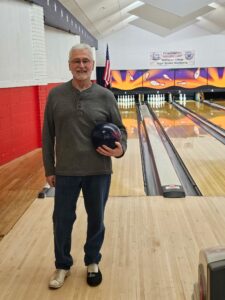
Young started bowling again two weeks after his stroke.
According to the American Stroke Association, 80 percent of strokes may be preventable with lifestyle changes, such as quitting smoking, improving nutrition, increasing physical activity and treating high blood pressure, cholesterol, high blood sugar and obesity.
“That means the other 20 percent occur due to things you can’t change, like genetics and ethnicity,” Kreiner adds. “However, if you have a stroke, but you lead a healthy lifestyle and get prompt care, you can minimize the effects.”
She emphasizes the importance of calling for help if you suspect stroke.
“Even if you’re scared, if you think you might be having a stroke, call 911,” Kreiner reiterates.
“It’s imperative to get care as fast as possible. It can mean the difference between being independent and doing the things you want to do and being dependent on a caregiver for the rest of your life.”
What's next
- Know the signs of stroke
- Learn about stroke treatment at MultiCare
- Find a provider near you to talk about your risk of stroke