Finding a new voice: Device allows man who lost speech to connect again

At 35 years old, Donovan “Stuart” Dean can finally tell you exactly what he thinks, thanks to the help of a rehabilitation clinic and a communication device.
Stuart Dean was a toddler when he was diagnosed with autism and developmental disabilities. He was just beginning to learn his first words when epileptic seizures disrupted those early language connections.
With speech therapy, Stuart Dean would relearn language, only to lose it again after another major seizure. It became a long and exhausting cycle for him and his family.
Then, in 2022, he contracted COVID-19 — and this time, his speech did not return.
“We thought he would bounce back,” says his mom, Marti Dean. “But he just stopped talking.”
A new way to communicate
In 2024, Stuart Dean met Hollylu Coon, a speech language pathologist at MultiCare Good Samaritan’s outpatient rehab clinic.
It didn’t take long for Coon to determine that he would benefit from a speech-generating device, often called a “talker.” These medical-grade devices give minimally verbal communicators a reliable way to express themselves, providing a “voice.”
After a comprehensive evaluation and trials, Stuart Dean received his communication device at the end of 2024. The change in him has been remarkable, says Marti Dean.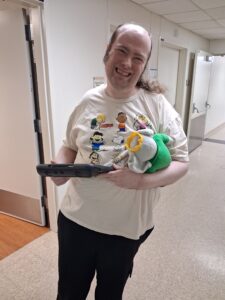
Now, when the Dean household — which includes dad Dugan and his three sons — sit to binge-watch episodes of South Park or SpongeBob SquarePants, it’s a lively, laughter-filled scene.
“Stuart laughs in the right places,” his mom says. “He likes to laugh. For so long, we thought his intellectual capacity was limited — that he wasn’t able to learn. Now, he can say and show us things that we didn’t realize he knew.”
Connection builds confidence
Equipped with his device, Stuart Dean began attending group sessions and monthly hangouts designed for patients like him and their families.
Coon developed the program in 2024 to create opportunities for adult patients using speech-generating devices to practice communication outside of formal therapy. Together, the community helps each other build confidence and social skills using their talkers.
The hangouts have been successful, drawing upward of 30 patients along with their family members and caregivers. Each session offers activities designed to encourage meaningful communication, not just with staff, but with peers and families. Participants also receive simple challenges to practice at home between sessions.
At first, Stuart Dean was hesitant. He’d participate only when called on directly and with encouragement from his dad. But as he continued attending, his confidence grew and his proficiency with the device skyrocketed.
Family members and fellow participants have noticed Stuart Dean’s growing skill with his device, and his increased engagement and social connection.
“Stuart really comes to life when he is working with the others,” says Marti Dean. “He loves the therapists and going to the hangouts. They have created a good environment where he can be expressive.”
Stuart Dean is excelling not only in the group setting, but at home, too.
“We’re seeing that he’s happier now,” his mom says, “and we have been more successful at home with spoken language because of the support he receives from Hollylu.”
Robert Burke is a supervisor for outpatient therapies at MultiCare Good Samaritan. If you need speech therapy, please call the clinic for more information: 253-697-7900.
What's next
- Learn more about MultiCare rehabilitation services
- Overcome your physical limitations with the MultiCare occupational therapies team
- Read more inspiring stories from our MultiCare patients