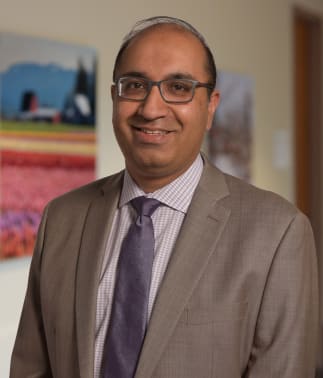
Arun Sharma, MD
Arun Sharma, MD, is a board-certified otolaryngologist and fellowship-trained head and neck oncologic surgeon who specializes in treatment of head and neck cancer. He treats cancers of the mouth, throat and voice box as well as salivary gland cancers, skin cancers and thyroid/parathyroid masses. He has advanced training in minimally invasive approaches, including transoral robotic surgery (TORS) and transoral laser microsurgery (TLM) for laryngeal lesions and cancers. Dr Sharma uses the single port robotic system to perform minimally invasive robotic surgery for oropharyngeal cancers. Dr. Sharma is one of just 217 surgeons to receive the inaugural Focused Practice Designation (FPD) in Adult Complex Thyroid and Parathyroid Surgery by the American Board of Otolaryngology – Head and Neck Surgery (ABOHNS) and the American Board of Surgery (ABS).
Dr. Sharma focuses on quality of life and incorporating patients into the decision-making process. He believes that patient education and involvement are key parts of caring for patients. Outside of work, Dr. Sharma enjoys traveling, hiking, kayaking, cooking and spending time with family.
The conditions Dr. Sharma treats include:
- Head and neck cancer
- Neck masses
- Thyroid nodules/masses and cancer
- Hyperparathyroidism
- Salivary gland (parotid, submandibular, and sublingual gland) nodules/masses and cancer
- Melanoma and other skin cancers of the head and neck
- Obstructive sleep apnea
- Zenker's diverticulum
The procedures Dr. Sharma performs include:
- Neck dissection
- Removal of benign and malignant neck masses
- Removal of oral cancers, including glossectomy and mandible resection
- Maxillectomy
- Endoscopic laser resection of laryngeal masses and cancers
- Total laryngectomy
- Pectoralis major flap
- Reconstruction of head and neck defects with local flaps, regional flaps, and skin grafts
- Transoral robotic surgery (TORS)
- Thyroidectomy
- Parathyroidectomy
- Parotidectomy
- Submandibular gland excision
- Removal of skin cancers of the head and neck
- Sentinel lymph node biopsy
- Surgery for obstructive sleep apnea, including drug induced sleep endoscopy (DISE), uvulopalatopharyngoplasty, transoral robotic (TORS) tongue base surgery, and hypoglossal nerve stimulator (Inspire) implantation
- Open and endoscopic surgery for Zenker's diverticulum
Dr. Sharma is featured in Seattle Magazine's annual list of the Top Doctors in the Puget Sound for 2025.
- MultiCare Medical Partners
- Robotics in Otolaryngology (https://www.oto.theclinics.com/article/S0030-6665(20)36680-9/fulltext)
- Prevalence and Factors Associated With Oral Cavity and Pharyngeal Cancer Screening in a Rural Population (https://pubmed.ncbi.nlm.nih.gov/34926974/)
- Marijuana use among US adults with cancer: findings from the 2018-2019 Behavioral Risk Factor Surveillance System (https://pubmed.ncbi.nlm.nih.gov/35397761/)
- Trends in Diagnosis of Noninvasive Follicular Thyroid Neoplasm With Papillarylike Nuclear Features and Total Thyroidectomies for Patients With Papillary Thyroid Neoplasms (https://pubmed.ncbi.nlm.nih.gov/34817546/)
- Evaluating the Rising Incidence of Thyroid Cancer and Thyroid Nodule Detection Modes: A Multinational, Multi-institutional Analysis (https://pubmed.ncbi.nlm.nih.gov/35834240/)
- Rapid telehealth implementation into an otolaryngology practice during the COVID-19 pandemic (https://pubmed.ncbi.nlm.nih.gov/34195358/)
- Salivary duct carcinoma: An aggressive salivary gland malignancy with opportunities for targeted therapy (https://pubmed.ncbi.nlm.nih.gov/29103750/)
- Survival and Gastrostomy Prevalence in Patients With Oropharyngeal Cancer Treated With Transoral Robotic Surgery vs Chemoradiotherapy (https://pubmed.ncbi.nlm.nih.gov/27347780/)
- A 20-Year Review of 75 Cases of Salivary Duct Carcinoma (https://pubmed.ncbi.nlm.nih.gov/26939990/)
- Hospital volume is associated with survival but not multimodality therapy in Medicare patients with advanced head and neck cancer (https://pubmed.ncbi.nlm.nih.gov/23456789/)
- Human papillomavirus-positive oral cavity and oropharyngeal cancer patients do not have better quality-of-life trajectories (https://pubmed.ncbi.nlm.nih.gov/22275190/)
Locations